Choosing the screw diameter first is a costly mistake: flour, grain, fertilizer, chemicals and abrasive powders place different demands on the flight, casing, speed and drive. By comparing material properties, conveyor geometry, capacity calculations and starting conditions, you can define a machine that fits the duty instead of relying on a catalogue rating.
Key takeaways
- Specify density, moisture, temperature, abrasiveness and flowability before choosing diameter.
- Use inclined, horizontal, vertical or flexible layouts to match transfer points and space.
- Calculate required capacity and loaded-start torque before selecting screw speed and drive.
- Compare suppliers using a written duty specification, drawings, materials and service commitments.
Start with the material, not the screw diameter
Bulk density, particle size, moisture, temperature, abrasiveness, corrosivity, flowability and required rate decide the construction and flight design before diameter. A material screw conveyor for bulk handling in Nagpur that carries dry flour needs a different casing, seal and operating speed from one carrying wet fertilizer or hot abrasive ash.
| Construction material | Suitable duty | Main caution |
|---|---|---|
| Mild or carbon steel | Grain, sand, aggregates and general dry solids | Protect against monsoon moisture, condensation and corrosion with suitable paint, covers and drainage |
| Stainless steel 304 | Flour, food ingredients, pharmaceuticals and washdown areas | Specify smooth welds and sanitary finishing where product retention matters |
| Stainless steel 316 | Chloride-bearing salts, corrosive chemicals and acidic powders | Higher cost is justified only when the chemical exposure demands molybdenum-bearing steel |
| Abrasion-resistant steel or replaceable liners | Silica, minerals, clinker and abrasive fertilizer | Liners protect the casing but add clearance and maintenance requirements |
Use a standard constant-pitch flight for controlled conveying of free-flowing grain or powder. For hopper withdrawal, choose variable-pitch, tapered-flight or progressive-capacity geometry; a plain screw can pull from one region, causing ratholing and surging rather than steady feed.
Choose ribbon flights for sticky materials that cling to solid flights, and paddle or cut-flight sections when mixing or breaking deposits matters. Fragile granules need slower speed and gentler handling because raising rpm increases degradation, dust and wear.
An industrial material screw conveyor handling flour, sugar, starch or polymer dust also needs a combustible-dust assessment, bonding, grounding, dust-tight joints and correctly rated electrical equipment. State the material range, moisture, temperature, rate, flight type, fill level, seals and acceptable leakage in the specification so quotations describe the same duty.
Match the conveyor configuration to the line layout
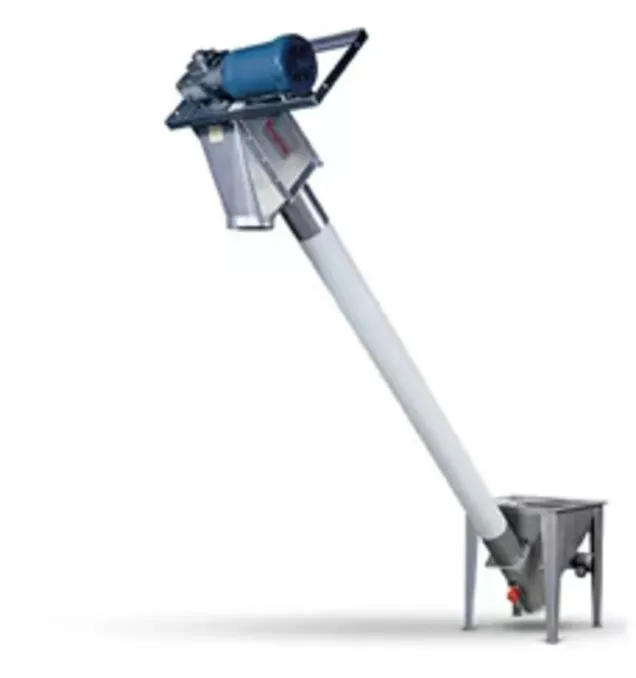
A horizontal conveyor is the default when floor space permits: it delivers the most predictable capacity and lowest power demand. Use an inclined unit only when elevation is unavoidable; practical capacity falls about 10% at 10°, 26% at 15°, and 55% at 30°.
| Option | Choose it when | A better choice when |
|---|---|---|
| Horizontal | The line has level transfer points and a long, steady route | A bucket elevator or belt conveyor suits a long-distance route |
| Inclined | You need modest elevation over a short distance | Elevation is high or capacity loss would require an oversized screw |
| Vertical | You need compact, controlled lifting between close levels | A bucket elevator handles greater height or throughput |
| Tubular | A screw conveyor for powder materials needs dust containment, sealed ends and controlled aeration | Open access matters more than containment |
| Trough | You need accessible conveying, inspection or frequent cleaning | Fine powder leakage or contamination is unacceptable |
| Flexible | The route has several small offsets and the product is free-flowing | The product is abrasive, hot, fragile or the route is long |
| Shafted | The material flows freely and the conveyor needs hanger support over a long span | Hangers could trap, contaminate or catch stringy product |
| Shaftless | Sticky, cohesive or dewatered material would plug around a centre shaft | The product needs high speed, long conveying distance or tight torque control |
Confirm inlet geometry before selecting shaftless equipment; a bridged hopper will defeat any screw design. For combustible powder, specify grounding, dust-tight joints, ignition control and explosion isolation rather than assuming an enclosed conveyor is safe.
Calculate capacity before selecting diameter and speed
A screw’s nominal diameter does not equal its delivered throughput. Calculate the duty point in kg/h or t/h from diameter, pitch, rotational speed, loading percentage and bulk density, then check how length and incline reduce practical performance.
1. Record the material’s minimum and maximum bulk density, required feed rate and allowable fill. A calculation based on 600 kg/m³ will undersize the industrial material screw conveyor if the product reaches 900 kg/m³.
2. Calculate the theoretical rate from screw cross-sectional area, pitch, rpm, loading and density. Use CEMA capacity methods rather than a catalogue diameter alone. A larger diameter increases volume per revolution; a larger pitch and higher speed increase flow, but excessive rpm can create dust, degradation, power demand and abrasive wear.
3. Include conveyor length in the power and loaded-start check. Length does not directly reduce horizontal volumetric capacity, but it increases friction, torque and the chance of buildup, so a long bulk handling conveyor in Nagpur needs a capacity calculation tied to its actual drive duty.
4. Apply an incline correction before accepting the result. A common screening guide reduces capacity by about 10% at 10°, 26% at 15°, 37% at 20°, 45% at 25° and 55% at 30°. Confirm the figure through material testing because slip depends on pitch, loading and flowability.
If the screw withdraws material from a hopper, size it as a feeder, not merely a conveyor. Variable-pitch, tapered-flight or progressive-capacity geometry controls extraction better than a constant-pitch screw.
Size the drive for loaded starts, wear and site conditions
A material screw conveyor for bulk handling in Nagpur needs a drive sized for the worst start, not merely the running load. Calculate steady-state power from torque, screw speed, length, incline and material resistance, then apply the manufacturer’s service factor for starts, wear and duty severity. Use CEMA calculations rather than a catalogue motor size.
Specify these drive inputs:
- Starting full, with a compacted inlet or inclined flight
- Required breakaway torque and continuous running torque
- Screw speed and gearbox output torque
- Motor rating after efficiency and service-factor allowances
- 415 V, three-phase, 50 Hz supply, unless the site provides another arrangement
- VFD or soft starter requirement, including acceleration time
Select the gearbox ratio from the required screw rpm and motor speed; do not reduce speed by throttling an oversized motor. An inclined conveyor needs a backstop or brake where reverse rotation could empty the line dangerously.
Protect the drive against overload, short circuit, phase loss, under-voltage, and motor overheating. Use a dust- and rain-resistant motor, junction box and cable glands; choose IP-rated equipment for the actual enclosure location. For Nagpur’s monsoon and dusty conditions, specify covered connections, drainage, sealed bearings and corrosion-resistant fasteners.
If flour, grain or polymer dust is combustible, add bonding and grounding, ignition control, explosion isolation and venting or suppression through a formal dust-hazard assessment.
Write a duty-based purchase specification and compare suppliers
A quotation is comparable only when every bidder prices the same duty point. State the minimum and maximum feed rate in kg/hour, bulk-density range, moisture, particle-size range, temperature, abrasiveness, corrosivity, flowability, conveyor length and inclination. For a bulk handling conveyor in Nagpur, include monsoon exposure, washdown water, condensation and dust conditions.
- Specify screw diameter, pitch, rotational speed, loading percentage, fill level and CEMA calculation basis.
- State casing and flight material, surface finish, trough or tubular construction, inlet and outlet sizes, covers, seals, bearing arrangement and acceptable leakage or carryback.
- Require motor rating, gearbox ratio, starting torque, service factor, voltage, phase, frequency, enclosure rating and overload protection.
- For a screw conveyor for powder materials, state flooding, bridging, aeration, dust-collection connection, shaft-seal type and combustible-dust controls.
- Require guaranteed throughput at the stated density and speed, plus the test method and acceptance tolerance.
Compare quotations using evidence, not catalogue capacity.
| Comparison point | Supplier 1 | Supplier 2 |
|---|---|---|
| Duty calculation | CEMA sheet at your density, speed and incline | Catalogue rating only |
| Construction | Material grades, thicknesses, finish and seal drawing | General “mild steel” or “stainless steel” |
| Drive | Motor, gearbox, service factor and loaded-start torque | Motor power alone |
| Site suitability | Outdoor protection, drainage and electrical details | Standard enclosure stated |
| Acceptance | Test procedure, drawings and deviation schedule | Price and delivery only |
A Nagpur manufacturer such as Unique Enterprises can support a fair comparison by issuing a dimensioned general-arrangement drawing, duty datasheet, drive calculation and itemised deviation list for its industrial material screw conveyor. Compare those documents line by line.
Related product
 | Unique Material handling Screw Conveyor ₹45000 A screw conveyor, also known as an auger conveyor, is a widely used device in material handling systems for transporting bulk materials. View product → |
Frequently asked questions
What material properties determine screw conveyor selection?
Start with bulk density, particle size, moisture, temperature, abrasiveness, corrosivity, flowability and required conveying rate. These factors determine the flight design, casing, seals, material of construction and operating speed.
How should you match a screw conveyor to the plant layout?
Choose the configuration that fits the transfer points and available space. Horizontal conveyors suit level movement, inclined units lift material, vertical designs handle significant elevation changes, and flexible screws suit compact routing around obstacles.
Why calculate capacity before choosing conveyor diameter?
Capacity calculations connect the required mass or volume rate with screw diameter, pitch, speed, fill level and material bulk density. Selecting diameter first can leave the conveyor under-capacity or cause unnecessary power and equipment costs.
What should you include in a screw conveyor purchase specification?
State the material, bulk density, particle-size range, moisture, temperature, corrosiveness, abrasiveness, capacity, conveyor length, inclination, inlet and outlet positions, duty cycle, construction materials, seals, drive requirements and site conditions.
Keywords